The classroom note
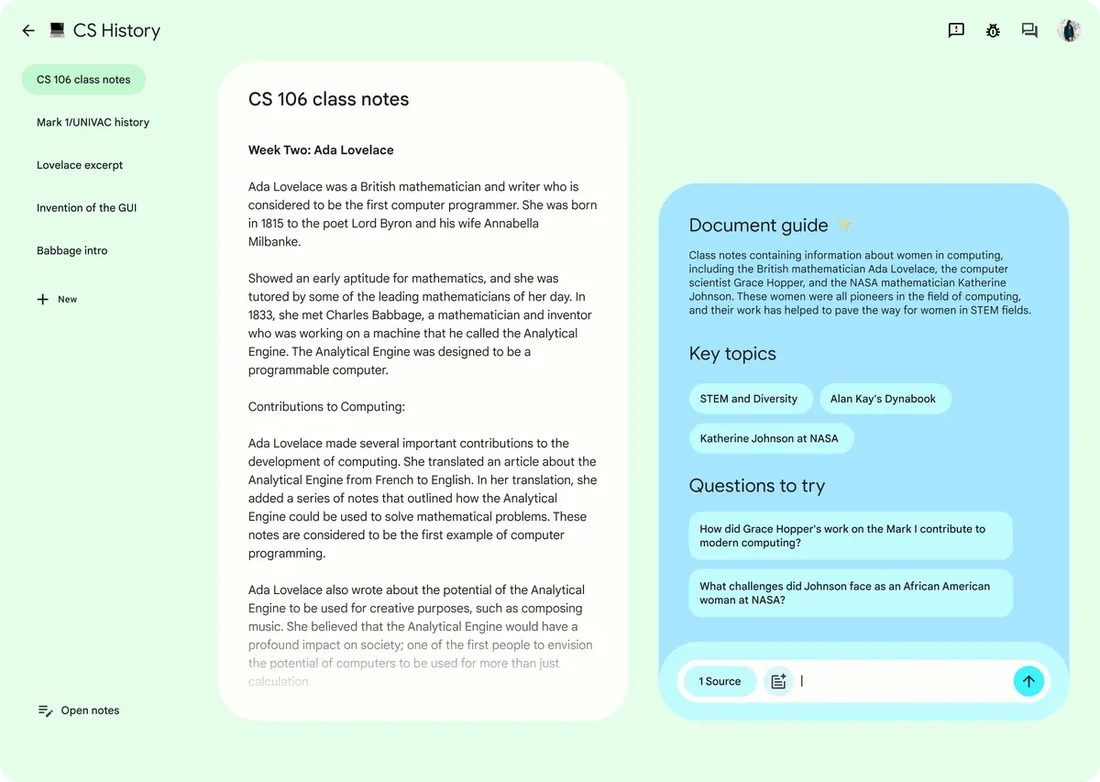
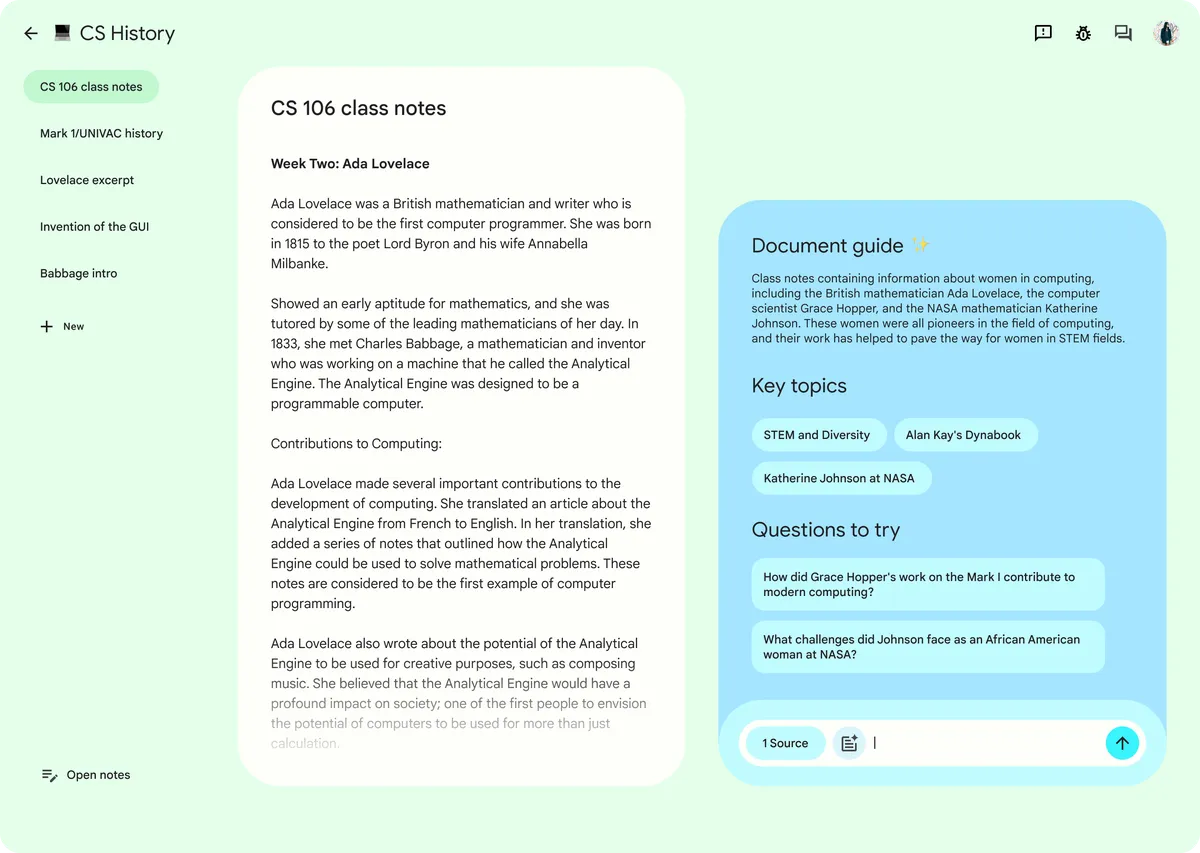
On 12 July 2023, Google opened an experimental note-taking tool to "a small group of users in the U.S.," built on a different premise from a general chatbot. The launch post describes NotebookLM as a tool a student could "ground" in their own uploaded documents rather than in general training data, illustrated by a medical student uploading scientific articles to build a glossary. For a student used to a chatbot inventing plausible citations, the pitch was narrower: answers tied to sources the student chose.
What the evidence says
The launch post states that grounding responses in a user's own documents "does seem to reduce the risk of model 'hallucinations,'" while still recommending users "fact-check the AI's responses against your original source material," a hedge rather than a measured error rate; no accuracy figure accompanies the claim. It also states, for that 2023 group, "we do not use any of the data collected to train new AI models." The product has since been renamed Gemini Notebook and gained a spoken-audio feature; the help article Generate Audio Overview in Gemini Notebook, retrieved 16 September 2026, describes "deep-dive discussions between AI hosts" summarising uploaded sources in "80+ languages," while warning the audio "are AI-generated and may contain inaccuracies or audio glitches," including "random speaker switches" and a "third voice." A second page, on privacy and terms, states content "will not be used to directly train our foundational AI models, unless you choose to provide feedback," with Workspace and Education accounts "excluded from human review and AI model training even when providing feedback."
The implementation question
Source-grounding changes what to check, not whether to check at all. A grounded answer more likely traces to an actual passage, a narrower claim than a chatbot's unattributed response, but the hedge "does seem to reduce" is not elimination. The audio feature adds a separate layer a school should treat distinctly from the text tool: a synthetic discussion generated from sources carries its own acknowledged error risk, the glitches the help page itself names, on top of whatever risk exists in the underlying text.
What holds and what fails
What holds is the core distinction: an answer tied to a source a student supplied is more checkable than an ungrounded generation, and the training-data commitment now distinguishes Workspace and Education accounts from general consumer use. What fails is treating either the grounding or the audio feature as error-free; both carry the vendor's own acknowledgement of remaining inaccuracy, stated plainly rather than buried.
- When a student cites a Gemini Notebook summary, have they checked it against the actual passage in the source document?
- Does the school's account fall under the stronger Education data protections, or general consumer terms?
- Should an AI-generated audio overview be treated as a study aid to verify, not a standalone source?
A tool built to answer only from a student's own sources is a genuinely different mechanism from a general chatbot, and Google's pages are careful, in both the 2023 launch and the current help centre, to say grounding reduces rather than removes the need to check the answer.
Sources & reading trail
Google's own launch post describing source-grounding, the reduced-hallucination hedge, citations, and a same-day no-training-data commitment for the small initial user group.
Source published: 12 July 2023 · Retrieved: 16 September 2026
Living help article describing the audio-overview feature, its 80+ language support, and the vendor's own warning about AI-generated inaccuracies and glitches.
Source published: Not established · Retrieved: 16 September 2026
Living help article stating the current, feedback-conditional AI-training policy and stronger protection for Workspace and Education accounts.
Source published: Not established · Retrieved: 16 September 2026
Departments, studies and vendor documents establish the record; the implementation reading and the boundary are School AI Atlas editorial analysis. This retrospective draft does not imply the site published on the event date.