The classroom note
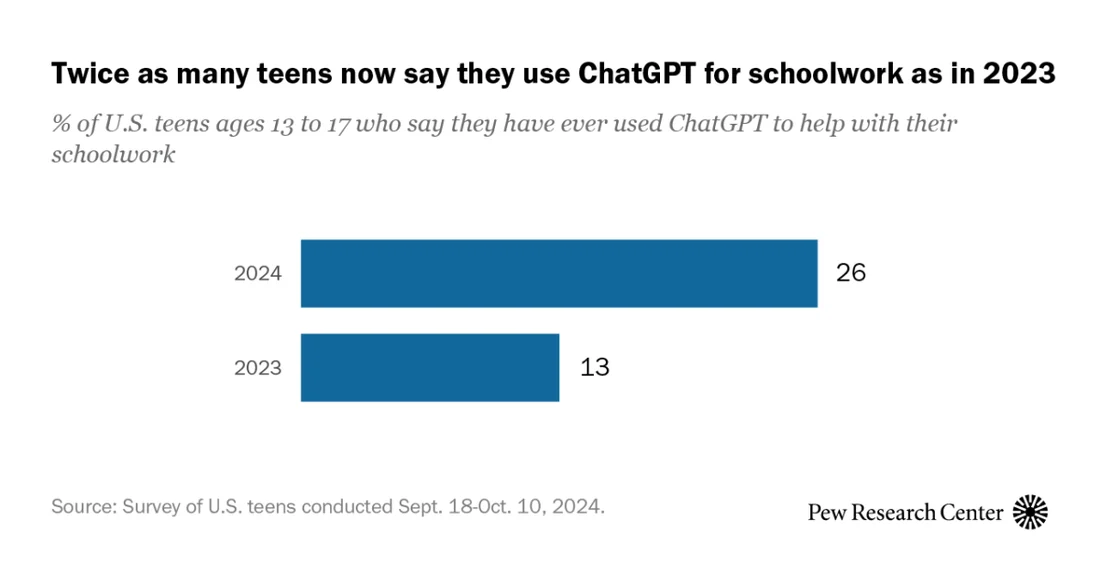
A ban on a school network does not reach a phone on a home Wi-Fi connection, and three nationally representative surveys, together, describe exactly that mismatch. Pew Research Center found 26% of US teens had used ChatGPT for schoolwork by late 2024, double the 13% measured in 2023. Common Sense Media's 2026 survey put the broader figure, across AI tools generally, at 70%. Neither number describes what happens at school; both describe what teens do regardless of what school allows.
What the evidence says
Each survey states its own design plainly. Pew surveyed 1,391 US teens aged 13-17 through Ipsos's KnowledgePanel in September and October 2024, finding ChatGPT use for schoolwork rising with grade level, 31% of 11th-12th graders versus 20% of 7th-8th graders, and higher among Black and Hispanic teens (31% each) than white teens (22%), a gap that did not exist in 2023; Pew reports no significant difference by household income. Common Sense Media's survey of more than 1,000 teens, published in August 2026, adds a mechanism: among the 70% who use AI for schoolwork, 44% have had a tool blocked at school, and 59% of those simply switched to a personal device to get around it. Only 27% said a teacher had ever discussed safe AI use with them.
The implementation question
A separate, teacher-facing survey shows where the asymmetry sits. RAND's survey of the American Educator Panels, covering the 2023-2024 school year, found 25% of teachers using AI tools for planning, but teachers and principals in higher-poverty schools used them less often than those in lower-poverty schools, and only 18% of principals said their district had issued AI guidance, falling to 13% in the highest-poverty schools against 25% in the lowest. Read against Pew's finding that use does not vary much by income, the picture is similar student use regardless of school wealth, layered onto a guidance gap that tracks poverty closely.
What holds and what fails
What holds, across all three, is that a rule enforced only on a school network does not change behaviour already moved to a personal device at home; Common Sense Media's data shows the block routed around by a majority of the teens it affects. What fails is treating school-side restriction as a fairness measure on its own: if use is roughly even by income but school guidance is not, restricting access without teaching verification leaves lower-income students navigating the same tool with less structured help, a reading these surveys support but none states outright.
- Does your school's AI policy assume it can prevent home use, or plan around the fact that it cannot?
- Has a teacher discussed safe or effective AI use with your child, or is that conversation not happening at all?
- Is AI guidance available equally across schools in your area, or concentrated in better-resourced ones?
Three surveys, three different sponsors, converge on one practical point: the gap that matters is not whether teens use AI for homework, which they already do broadly, but whether any adult has helped them use it well, and that help is not reaching students evenly.
Sources & reading trail
Nationally representative teen survey figures on ChatGPT use for schoolwork by year, grade, race and household income.
Source published: 15 January 2025 · Retrieved: 16 September 2026
Nationally representative teen survey on AI use for schoolwork, school-network blocking, device-switching and teacher AI-safety conversations.
Source published: 18 August 2026 · Retrieved: 16 September 2026
Nationally representative RAND survey on teacher and principal AI adoption and school guidance, broken down by school poverty level.
Source published: 11 February 2025 · Retrieved: 16 September 2026
Departments, studies and vendor documents establish the record; the implementation reading and the boundary are School AI Atlas editorial analysis. This retrospective draft does not imply the site published on the event date.