The classroom note
According to Khan Academy's own leadership page, Sal Khan, who holds 'three degrees from MIT and an MBA from Harvard Business School,' 'started Khan Academy in 2005 to help his cousins (and soon other people's cousins)' with remote tutoring, work that later moved onto video and became a standalone nonprofit. What began as one relative's tutoring became, on the organisation's own account, one of the largest single providers of free instructional video and practice exercises before any of today's AI tutors existed.
What the evidence says
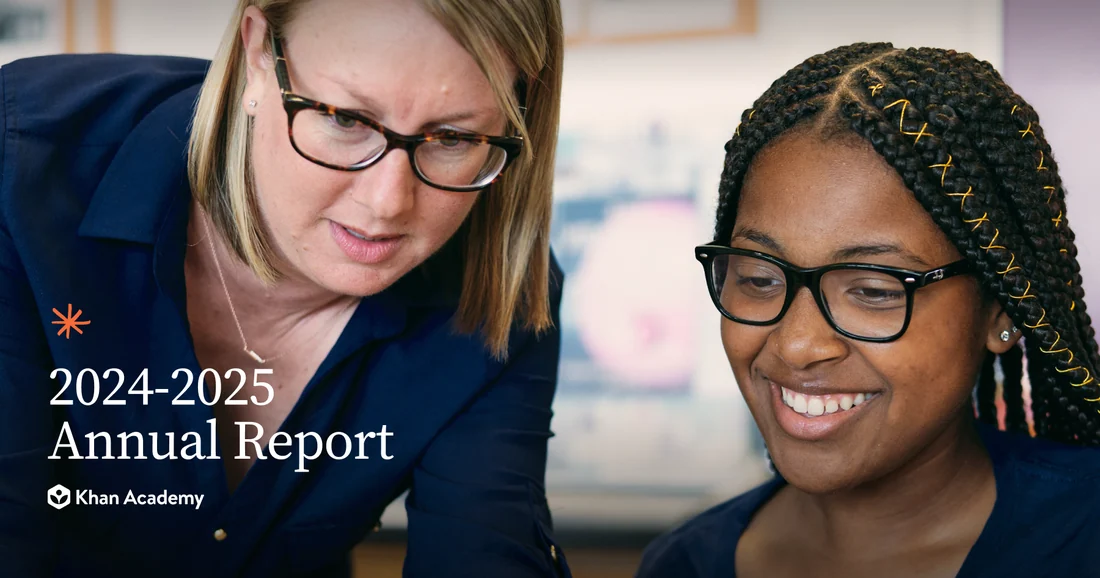
Both of Khan Academy's own reporting channels are self-published, not independently audited, and the two differ on current numbers depending on when each was last updated, a normal feature of a living organisational website rather than a contradiction. As retrieved on 16 September 2026, the current about page states the organisation reaches '227 million registered users' across '190+ countries and 55+ languages,' accumulating '75 billion learning minutes.' Its annual report for school year 2024-25 gives a fixed snapshot for that year specifically: '189.6 M Registered Users,' '66.8 B Learning Minutes,' '104.9 M Yearly Active Learners,' and organisational finances of '$128M Total' revenue against '$95M Total' expenses. The same report states '2.0 M Total Global Khanmigo Users,' Khan Academy's own generative AI tutor.
The implementation question
The nonprofit structure is the operative fact for procurement: a district or family accessing Khan Academy is not paying per seat, and the organisation's own materials frame its revenue as donor support rather than tuition or licence fees, which changes who bears the cost of scale and who can withdraw funding. That structure, built and tested for two decades on video lessons and practice exercises, is also the base the same organisation says it now uses to run Khanmigo, a fee-adjacent AI product layered onto free infrastructure — a different cost model from a school signing a new AI vendor contract from nothing.
What holds and what fails
What holds is scale that is genuinely large by any measure available here, sustained for two decades on a donation-funded, non-tuition model. What fails is treating 'free' as meaning costless: the annual report's own $95 million expense figure for one year shows the scale itself carries a real, ongoing funding requirement that donor support must keep meeting, a dependency a school inherits indirectly whenever it relies on the platform continuing to exist in its current form.
- Is a tool's nonprofit or 'free' status being taken to mean the underlying cost has disappeared, or just been relocated to a donor?
- Which figure is being quoted — a live counter, or a fixed year's snapshot — and does that match the claim being made?
- What happens to a school's practice if a donor-funded platform's usage or funding changes?
Two decades of free-tier scale is the argument Khan Academy's own materials make for extending trust to its newer AI tutor; that argument rests on the nonprofit's continued funding, not on Khanmigo having been separately measured here.
Sources & reading trail
States that Sal Khan started Khan Academy in 2005 out of remote tutoring for family members.
Source published: Not established · Retrieved: 16 September 2026
Gives fixed school-year figures for registered users, learning minutes, revenue, expenses and Khanmigo users.
Source published: Not established · Retrieved: 16 September 2026
States the organisation's current live reach figures and its 501(c)(3) nonprofit, donor-supported status as retrieved 16 September 2026.
Source published: Not established · Retrieved: 16 September 2026
Departments, studies and vendor documents establish the record; the implementation reading and the boundary are School AI Atlas editorial analysis. This retrospective draft does not imply the site published on the event date.