The classroom note
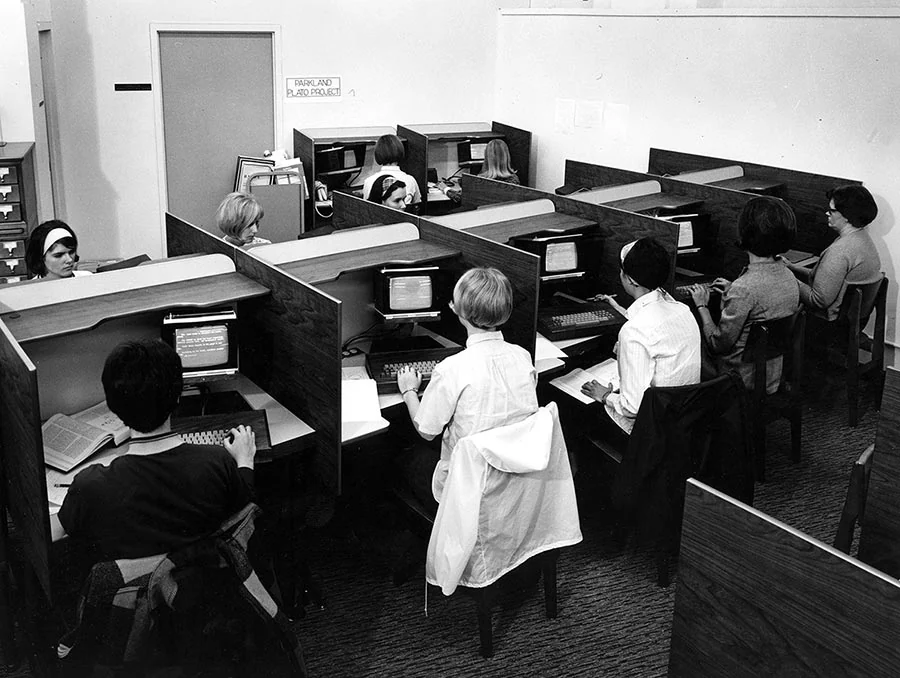
In 1960, at the University of Illinois, engineers Chalmers Sherwin and Donald Bitzer began building what their own department now calls the world's first time-shared computer-based education system, inside a new Computer-based Education Research Laboratory. The system, the department's own history page states, was named PLATO, for Programmed Logic for Automated Teaching Operations. A student at a PLATO terminal could work through a lesson, answer questions and get a response in something close to real time, decades before a home computer existed to compare it with.
What the evidence says
The university's own public exhibit record states that PLATO 'originated in the early 1960s' under a team 'initially led by Donald Bitzer,' and that 'by the late 1970s, PLATO was comprised of several thousand terminals worldwide' — a plain claim of reach, not an audited enrolment count. The exhibit also states the system 'functioned for four decades,' while a companion page on PLATO's impact gives one line on its decline: 'by the late 1980s, PLATO's mainframe-based system was losing popularity as microcomputers were becoming more popular.' None of these pages offers a controlled comparison of learning outcomes on PLATO against ordinary classrooms; all three are institutional retrospectives, not evaluation studies.
The implementation question
The decline story is, at heart, about hardware economics. PLATO ran on shared mainframe terminals, engineered and networked at a central site; Bitzer's lab is separately credited, in the same department history, with inventing the plasma display used on later PLATO terminals, in 1964, a display expensive enough that a single terminal was a serious institutional purchase. A personal computer, arriving through the 1980s, needed no shared mainframe and no specialised terminal. The lesson translates directly: a shared, centrally hosted system can offer capability an individual machine cannot, but it also concentrates cost and dependency at that centre, and when a cheaper decentralised alternative reaches a workable threshold, the economics can reverse quickly, independent of whether the centralised system taught better.
What holds and what fails
What holds, on the university's own account, is that PLATO worked as engineering and sustained a real user base across four decades — a genuine achievement most schools did not see again in shared, hosted software until much later. What fails is any claim that scale or longevity is evidence of instructional effectiveness; the exhibit pages document reach and hardware history, not learning gains. Treating 'thousands of terminals' as proof of pedagogical success would be an editorial overreach the sources themselves do not make.
- Is a system's terminal or user count being offered as proof of educational effectiveness it was never measured against?
- Does a centrally hosted tool concentrate cost and dependency in a way a decentralised alternative would not?
- What happened to the infrastructure, and the students relying on it, when the underlying economics shifted?
PLATO's four-decade run and its eventual eclipse by microcomputers is a precedent worth holding against any AI tool sold on the strength of its infrastructure alone: infrastructure can be real and still say nothing about what students learned from it.
Sources & reading trail
University exhibit stating PLATO's early-1960s origin under Bitzer, its growth to several thousand terminals by the late 1970s and a four-decade run.
Source published: Not established · Retrieved: 16 September 2026
States that PLATO's mainframe system lost popularity to microcomputers by the late 1980s.
Source published: Not established · Retrieved: 16 September 2026
Confirms the exact 1960 founding date, the Computer-based Education Research Laboratory, Sherwin and Bitzer, the PLATO acronym, and the 1964 plasma display.
Source published: Not established · Retrieved: 16 September 2026
Departments, studies and vendor documents establish the record; the implementation reading and the boundary are School AI Atlas editorial analysis. This retrospective draft does not imply the site published on the event date.