The classroom note
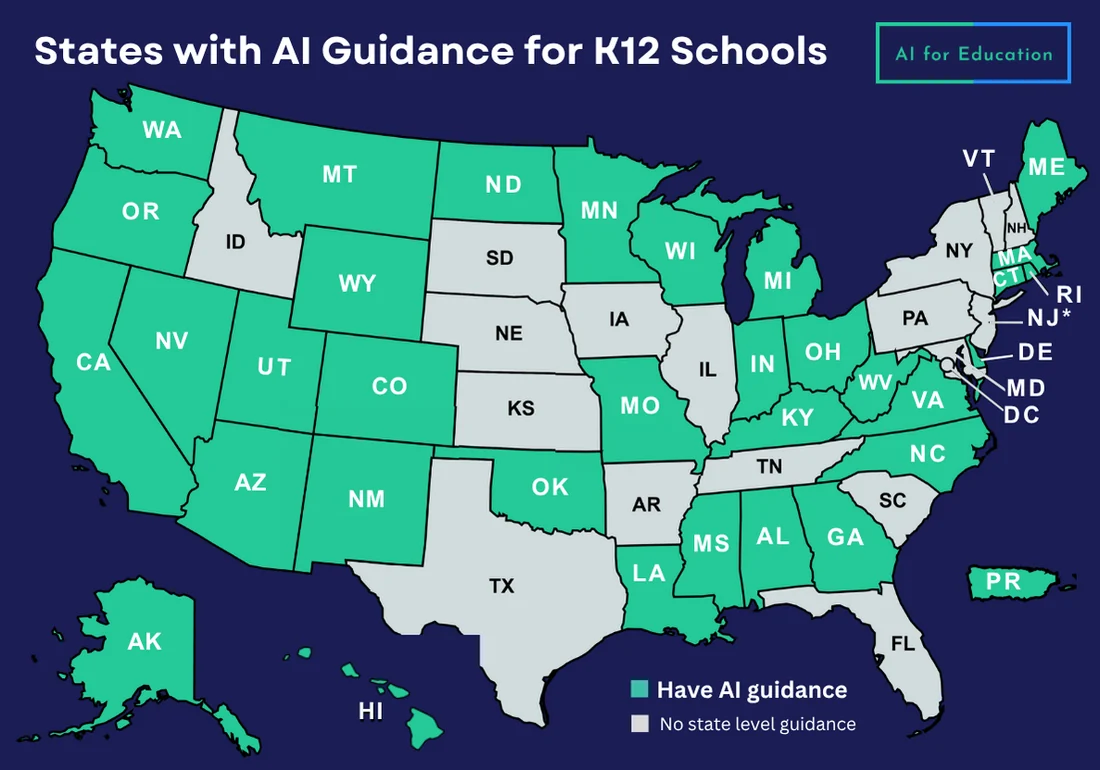
A district administrator searching for 'what other states are doing' on AI usually lands on one of a handful of trackers, and the most commonly cited is run by AI for Education, a company whose own tracker page states that '35 states (and Puerto Rico) now have official guidance or policy on the use of AI in K12 schools,' updated, as the page itself notes, on 8/21/2026. The tracked guidance typically covers definitions, ethical principles, data-privacy compliance with FERPA, COPPA and CIPA, academic-integrity language, vendor-procurement advice and AI-literacy goals, according to the same source, but the tracker's count treats issuing guidance, not funding or requiring anything, as the unit of adoption.
What the evidence says
The 35-state figure is a count maintained by an interested party: AI for Education's own homepage describes the organisation as a training and consulting firm 'trusted by 300+ education partners worldwide,' selling 'high quality PD and training' and 'practical governance frameworks' to the same schools its tracker is meant to inform. That is not evidence the count is wrong, but it is evidence the tracker is not neutral in the way a government statistical agency's count would be; a company that sells AI-adoption consulting has a plain commercial interest in states appearing to be moving in that direction. TeachAI's own materials describe a parallel toolkit for writing such guidance but do not themselves publish a competing state-by-state count, leaving this single tracker as the most cited figure without independent replication found among the sources checked here.
The implementation question
The mechanism the count obscures is that guidance is not funding. A state can appear on the tracker's map by publishing a document that costs little beyond staff time to write, while leaving districts to find their own budget for training, licences or the extra staff time the guidance itself recommends. A district reading '35 states have guidance' should ask a narrower question: does its own state's document come with money, a mandate, or neither, since the tracker's binary count does not distinguish a funded state mandate from an unfunded suggestion.
What holds and what fails
What holds is that a state-by-state count, however produced, gives a district a rough sense of how far guidance has spread and a starting list of other states' documents to compare against. What fails is treating the count as a measure of implementation, funding or effect: the source describes documents issued, not classrooms changed, and its commercial sponsor has not published, in the pages checked here, any independent measure of what difference the guidance made once issued.
- Does our state's guidance come with dedicated funding, or is it an unfunded recommendation?
- Have we checked whether the guidance's date predates or postdates the specific AI tools we are evaluating?
- Would we get a different answer from a tracker that does not also sell AI-adoption consulting?
A guidance count is a map of documents, not a map of classrooms; the distance between the two is exactly the part a tracker cannot see.
Sources & reading trail
States the count of 35 states plus Puerto Rico with K-12 AI guidance and the tracker's last-updated date.
Source published: Not established · Retrieved: 16 September 2026
States AI for Education's business as a paid AI training and consulting firm, relevant to assessing the tracker's neutrality.
Source published: Not established · Retrieved: 16 September 2026
Provides a comparison point: a coalition offering guidance toolkits without a competing state-count tracker.
Source published: Not established · Retrieved: 16 September 2026
Departments, studies and vendor documents establish the record; the implementation reading and the boundary are School AI Atlas editorial analysis. This retrospective draft does not imply the site published on the event date.