The classroom note
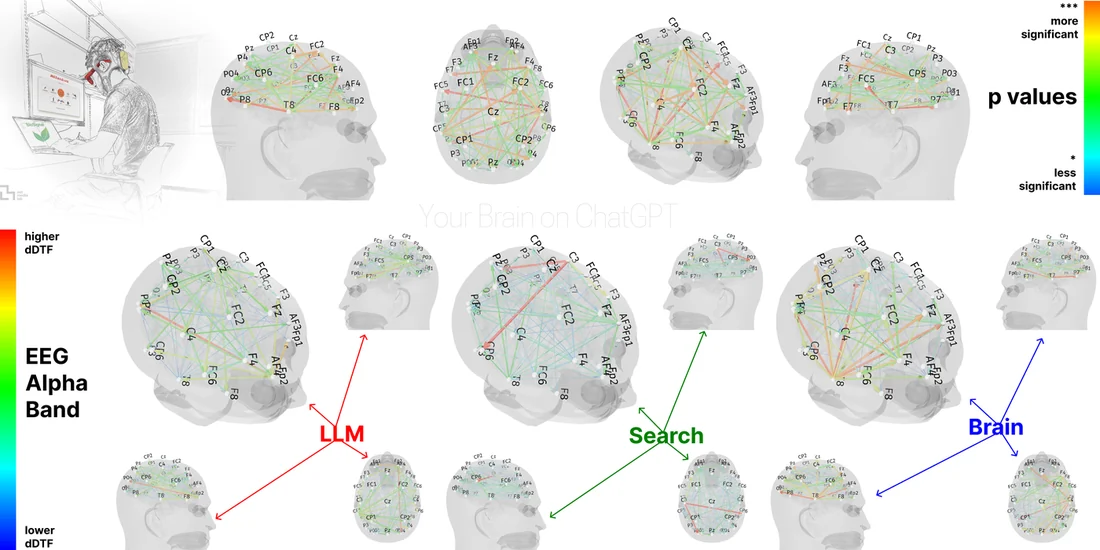
A widely shared claim in 2025 was that using ChatGPT to write essays gives students “cognitive debt”: weaker brain engagement lingering after the tool is put away. That phrase comes from a specific study, an MIT Media Lab preprint titled “Your Brain on ChatGPT”, first posted on arXiv on 10 June 2025 and explicitly labelled “Preprint, under review” on every page. Fifty-four participants wrote essays across three sessions using a chatbot, a search engine, or no digital tool, while researchers recorded EEG brain connectivity, then analysed the essays' language and asked participants to recall or quote what they had written. Four months later, 18 of those participants returned for a fourth session in which the chatbot and no-tool groups swapped conditions.
What the evidence says
Across the first three sessions, the no-tool group showed the strongest, most distributed brain connectivity, the search-engine group was intermediate, and the chatbot group weakest; chatbot users were also less able to recall or quote their own essays, and independent teachers reported recognising chatbot-assisted essays by their conventional structure. In session four, participants who had used the chatbot earlier and then wrote unaided showed weaker connectivity than the original no-tool group had shown months before. The MIT Media Lab's own project page states plainly the work “has not yet been peer-reviewed, thus all the conclusions are to be treated with caution and as preliminary,” and asks journalists to avoid words like “dumb” or “brain damage” that the data does not support.
The implementation question
The study's authors are unusually direct about scale: only 54 participants took part in the main comparison and just 18 completed the fourth session, where the most striking claim, a lingering effect months later, comes from. They recruited from a small number of academic institutions in one US metropolitan area, tested one product, ChatGPT, on one task, essay writing, and received no external funding for the work. None of that makes the finding uninteresting; it does mean a school cannot treat cognitive debt as an established fact about AI and the developing brain.
What holds and what fails
The finding holds as a carefully instrumented, if small, first look at how brain connectivity differs across three ways of producing an essay, with a research team candid about its own limits. It does not hold as evidence about younger pupils, other tasks, other chatbots, or a lasting change to the brain, none of which this sample size or design can support. This is an editorial judgement, not the authors': treating a preprint this size as a verdict on what AI does to children's brains is a bigger claim than the data beneath it.
- Is this finding from a peer-reviewed study, or a preprint still under review?
- How many participants does the specific number being quoted rest on?
- Does the claimed effect concern one task and product, or is it generalised past what was tested?
The authors built a genuine early signal worth further study; the caution they attach to it is as much a part of the finding as the EEG traces themselves.
Sources & reading trail
Preprint under review; gives the four-session design, sample sizes (54 then 18), EEG/NLP methods, results and the authors' own stated limitations.
Source published: 10 June 2025 · Retrieved: 16 September 2026
The lab's own page explicitly labels the work preliminary and not yet peer-reviewed, and cautions against overstated media framing.
Source published: Not established · Retrieved: 16 September 2026
Departments, studies and vendor documents establish the record; the implementation reading and the boundary are School AI Atlas editorial analysis. This retrospective draft does not imply the site published on the event date.