The classroom note
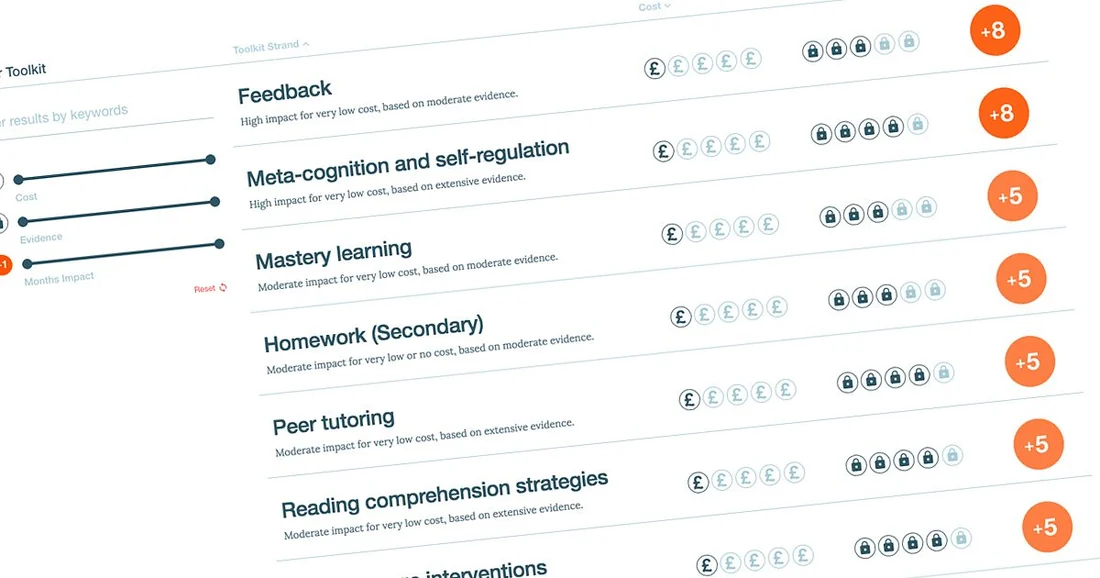
A teacher choosing between an AI feedback tool and marking by hand is really choosing between two different evidence bases, and it is worth separating them before buying either. The Education Endowment Foundation's Teaching and Learning Toolkit rates feedback 'high impact for very low cost based on extensive evidence,' reporting an average gain of six additional months of progress drawn from 155 identified studies, with the toolkit's own security rating for that evidence marked 'high.' Separately, a grading platform's own homepage tells instructors it lets them 'grade assignments in half the time,' a claim that sits on the company's marketing page with no study, sample or method attached.
What the evidence says
The EEF figure is a synthesis of many studies of feedback broadly, most of it human-delivered, not a study of AI specifically; the toolkit also covers feedback 'delivered by digital technology,' describing it as typically 'automated, pre-programmed feedback embedded in learning software,' and stating plainly that 'impacts are highest when feedback is delivered by teachers,' with technology-delivered feedback shown to have a smaller effect. The toolkit adds that 'as educational technology and generative AI continue to evolve rapidly, the nature and examples of such feedback are also likely to change,' an acknowledgement that its evidence base predates most generative AI grading tools. The 'half the time' claim, by contrast, is a single vendor's stated benefit with no sample size, no comparison marking method and no named study, appearing on a page designed to sell subscriptions, alongside Turnitin's own product pages for its similarly marketed Feedback Studio tool.
The implementation question
The mechanism worth separating is speed from quality: a tool can plausibly cut the minutes a teacher spends per script while providing feedback that moves learning less than a teacher's own comments would, and EEF's finding that teacher-delivered feedback outperforms technology-delivered feedback suggests a real trade-off rather than a pure gain. The practical cost question a school should ask is not only the subscription price but what proportion of a teacher's saved marking time is then spent reviewing and correcting the tool's output, a step the vendor claim does not account for.
What holds and what fails
What holds, on the evidence assembled here, is that feedback as a general teaching practice is well-evidenced and worth prioritising; what does not hold, because no cited source establishes it, is the claim that an AI-assisted tool matches or exceeds that benefit while also halving marking time. Treating a vendor's unsupported time claim as equivalent to EEF's 155-study evidence base is a category error; the two claims answer different questions and only one names its method.
- Does the tool's time-saved claim specify a sample of teachers or classrooms, or is it a general marketing statement?
- Has anyone tracked how much review time our own staff spend correcting the tool's draft feedback?
- Would EEF's finding that teacher-delivered feedback outperforms technology-delivered feedback change how we deploy the tool?
A vendor's time-saved claim and an evidence body's impact rating are not interchangeable currencies, and a school choosing a feedback tool should ask each one to show its own working.
Sources & reading trail
States the +6 months impact figure, 155-study evidence base, high security rating, and the caveat on technology-delivered and generative AI feedback.
Source published: Not established · Retrieved: 16 September 2026
States the vendor claim of grading assignments 'in half the time' with no stated basis.
Source published: Not established · Retrieved: 16 September 2026
Names Feedback Studio and Gradescope as the vendor's grading and feedback products.
Source published: Not established · Retrieved: 16 September 2026
Departments, studies and vendor documents establish the record; the implementation reading and the boundary are School AI Atlas editorial analysis. This retrospective draft does not imply the site published on the event date.