
The classroom note
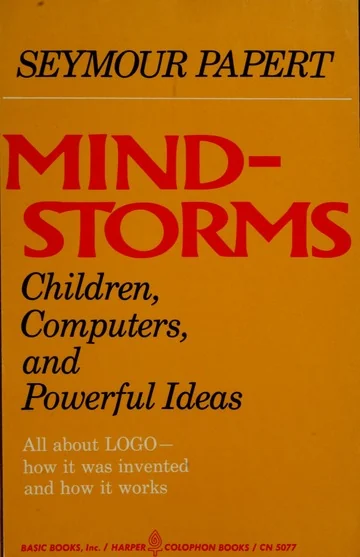
In 1980, the mathematician and MIT researcher Seymour Papert published Mindstorms: Children, Computers, and Powerful Ideas, a book whose library catalogue record confirms that publication year. Papert's argument, as the Logo Foundation's own history page summarises it, inverted the usual classroom relationship to computers: rather than a machine drilling a child with programmed questions, the child should program the machine. The vehicle for that argument, the Logo language, had already existed for over a decade — the same page records that Papert, working with Wallace Feurzeig's team at Bolt, Beranek and Newman, 'created the first version of Logo in 1967,' with small school trials at Brookline Public Schools before Mindstorms reached a wide audience.
What the evidence says
The Logo Foundation's account is an advocacy history, produced by an organisation built to promote Logo, not an independent evaluation. Read as a primary record of the movement's own claims, though, it is specific: Mindstorms's publication 'fuelled the Logo boom of the early 1980s,' and the underlying philosophy, which the foundation's page on Logo and learning calls constructionism, holds that 'a good way to support the building of knowledge in one's head is to build something in the real world — a computer program, a robot, a drawing, a story, or a musical composition.' That is a design principle for Logo, not a measured result; neither page cites a controlled study of Logo's effect on mathematical or programming achievement.
The implementation question
A classroom adopting Logo in 1980 needed a computer per group of students, a teacher confident enough to let a lesson go where a child's own programming led it, and time for open-ended projects inside a fixed timetable — none of them small asks when computers were scarce. The foundation's history traces incubation 'throughout the 1970s' at MIT and research sites abroad before wide use, which is itself evidence that turning a design philosophy into ordinary classroom practice took years of institutional groundwork, not a single book.
What holds and what fails
What holds is the underlying distinction Papert drew, between a child directing a machine and a machine directing a child, which remains a genuinely different design choice for any tool, generative AI included: does the software let a student build and test their own idea, or mainly deliver instruction to them. What fails, on these sources alone, is any evidence that constructionist design reliably produces better measured outcomes than instruction-first tools; that comparison is not made here, and treating it as settled would be an editorial overreach the sources do not support.
- Does the tool let a student direct it toward their own idea, or mainly deliver content to them?
- What institutional groundwork — hardware, teacher confidence, timetable space — does the design assume?
- Where is the outcome evidence, separate from the philosophy's own account of itself?
Papert's claim was about the direction of control between child and machine, not a specific measured gain; today's tutoring software raises the identical question in reverse, since a generative tutor that answers on demand can just as easily hand control back to the machine.
Sources & reading trail
States Logo's 1967 creation by Feurzeig's team with Papert, early school trials, and that Mindstorms (1980) fuelled the early-1980s Logo boom.
Source published: Not established · Retrieved: 16 September 2026
States the constructionist principle behind Logo's design, that building something in the world supports building knowledge in the mind.
Source published: Not established · Retrieved: 16 September 2026
Confirms the book's 1980 publication date.
Source published: 1 January 1980 · Retrieved: 16 September 2026
Departments, studies and vendor documents establish the record; the implementation reading and the boundary are School AI Atlas editorial analysis. This retrospective draft does not imply the site published on the event date.